
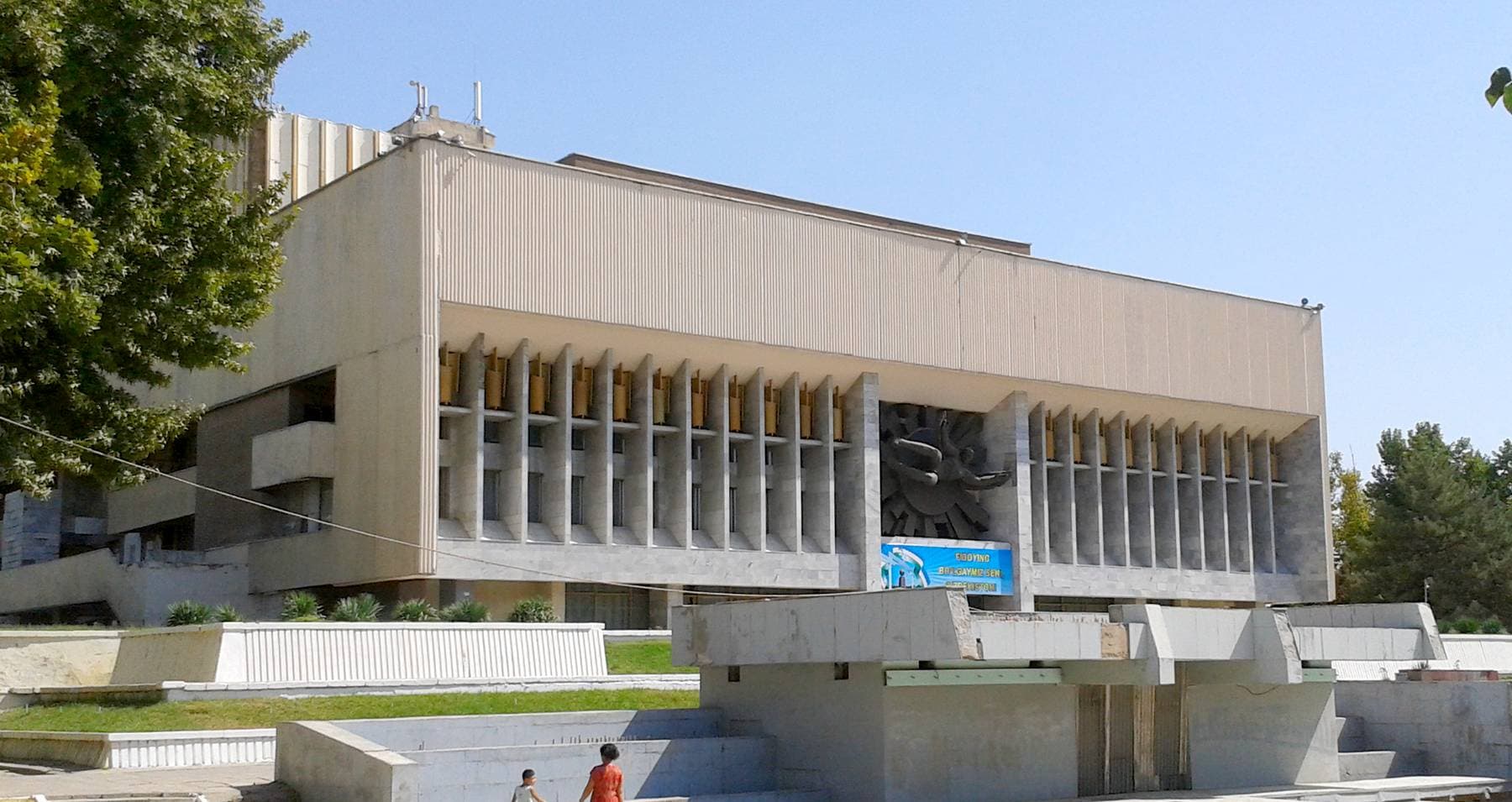
In the aviation builders’ town stands one of Tashkent’s most majestic buildings. Its design was crafted by a team of authors: architects A. Onishchenko, R. Takhtagunov, M. Vakhidov, Yu. Korostelyov, and engineers R. Nasretdinov, A. Talipov.
The palace was constructed in just four years —
quickly compared to other major city projects — thanks to the active
involvement of the enterprise. According to TAPOiCh employees’ recollections,
subbotniks (voluntary work days) were frequently held at the construction site
in 1979–1980.
The building’s main space is a 1,500-seat hall with
a superbly equipped stage, allowing audiences to enjoy performances and films
in comfort worthy of Tashkent’s finest cultural venues. Additionally, the
palace featured numerous leisure spaces: a library housing around 100,000
volumes, dozens of interest-based clubs, and amateur activity circles.
Particularly memorable were the choir performing
Russian folk songs, the dance circle led by L. P. Sevastyanova (from which the
“Lik” Movement Theater later emerged), and the “Gramophone” disco club uniting
lovers of contemporary music. The palace hosted New Year and professional
holidays, concerts, and “civil christenings” for factory employees’ children —
joint birthday celebrations for peers organized by the factory trade union.
For many years, the palace hall hosted meetings of
Uzbek KVN teams.
After aircraft production ceased at TAPOiCh, the
palace gradually fell into disrepair — no funds remained for its maintenance.
By a decree of the Cabinet of Ministers of
Uzbekistan dated August 29, 2013, the building, structures, and property of the
Aviation Builders’ Palace of Culture and Technology were transferred to the
Ministry of Defense under the name “Spiritual and Educational Center of the
Ministry of Defense of the Republic of Uzbekistan.”
In February 2020, the President visited the Center
and instructed its revival: reconstruct the building, create a modern cultural
and entertainment center, provide conditions for concerts and festive events,
improve the surrounding area, and open retail and service outlets.
In 2021, a special commission of international
experts invited to Uzbekistan by the Culture and Arts Development Foundation
reviewed the preservation and restoration of modernist architectural monuments,
including the Aviation Builders’ Palace — still referred to by its old name.
Restoration has not yet begun, but Tashkent
residents continue to hope that their beloved building with the soaring Icarus
will gain a second life and once again fill with voices, music, performances,
exhibitions, and a multitude of vibrant cultural events.
Once, this place was called Asakin Square — a major transport hub and one of the city’s main landma...
The teahouse on the Anhor canal bank was built in 1956 according to the design of architect V. M. D...
In 1968, a modern (for its time) House of Knowledge with a 600-seat hall opened on Kirov Street. Fo...
The conventional list of Tashkent's patron saints traditionally begins with Al-Kaffal al-Shashi, a ...